Austria at EXPO 2027 in Belgrade - concept development
EXPO 2027, under the guiding theme "Play for Humanity", articulates the ambition to make play, movement, and music accessible as universal human practices and to engage an international audience independent of language. What is expected is not an object, but a system that enables experience. My conceptual practice begins where given requirements are translated into structure.
The pavilion is conceived as a spatial expression of Austria and makes its attitude, innovation, way of thinking, and cultural competence internationally perceptible and visible.
Based on these premises, I have developed a spatial installation in which movement organizes perception. The roller coaster functions as a central structuring element within a larger constellation of space, sound, light, and human presence. It describes a continuous line through space that orders rhythm and time. This dynamic is not understood as an event, but as a state. Space becomes perceptible as a temporal configuration.
The installation connects physical experience, sound, and visual translation into a coherent system. Rhythm generates sound; sound is translated in real time into color, form, and light. Two large-scale LED walls function as the visual surface of this process. Sound, image, and spatial dynamics are directly interconnected and continuously evolving.
The installation is designed so that participation emerges through presence. Riding and standing visitors share a perceptual space that extends into the exterior through the glass walls. Acoustic and visual processes also include people outside the enclosed space. Visitors may actively engage or observe. Play unfolds as interaction. Sport appears as physical movement in space. The ride directly activates the body and translates movement into tangible parameters such as rhythm, balance, and acceleration. In this way, sport becomes a universal, non-conditional experience and, as part of the overall installation, accessible to all, in the sense of Play for Humanity. Sound emerges as a process generated by movement and presence.
In accordance with the requirements of the EXPO 2027 call, architecture is an integral part of the concept and serves the spatial organization of experience, participation, and public presence. It functions as the structuring envelope of the installation, organizing visitor flow and openness while establishing a deliberate connection between interior and exterior, without asserting itself as an autonomous object. The glass walls open the installation to the outside. The visual processes unfolding within become part of the public realm. Light, color, and movement enter into a relationship with the surroundings, rendering the entire process visible. Perception is shared.
I developed this concept for Austria because my own way of working aligns with an attitude I experienced there as self-evident: the understanding that complexity does not need to be reduced in order to be accessible. Perception may take time; experience is allowed to unfold. Design means creating conditions under which processes become visible. I perceived Austria as a place where art, technology, economy, and everyday life are not strictly separated. Collaboration arises from mutual respect and from the awareness that different competencies are part of a shared system. The installation emerged from a concrete relationship, from a working reality, from encounters, and from a shared understanding of time, space, and responsibility.
My decision to conceive this concept for the Austrian Pavilion at EXPO 2027 arises from this proximity. Austria is not merely represented, but embodied—through an attitude that connects perception, play, movement, and participation.
Pantha rhei, everything flows, forms the conceptual foundation of this installation. It organizes flow as a spatial experience and renders Play for Humanity visible as a lived process. The work unfolds through the interplay of space, sound, image, and human presence.
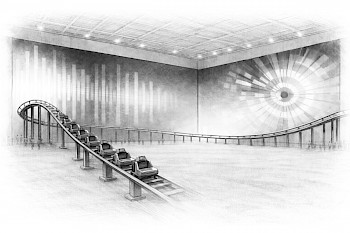
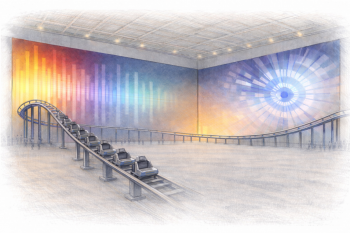
Interior view of the austrian pavilion, ground area 20 × 30 m, height 10 m
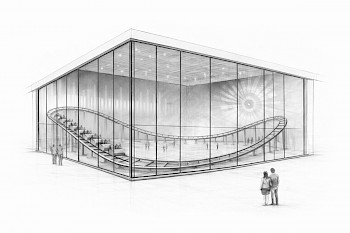
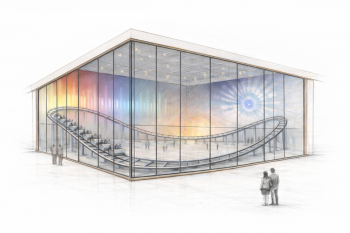
Exterior view
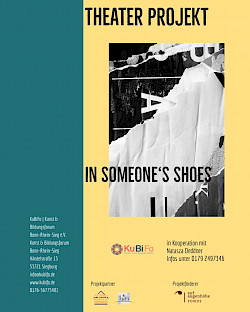
in someone‘s shoes
in someone’s shoes is an intercultural theatre project that creates an artistic space for people with migration and refugee experiences to make their personal stories, experiences, and perspectives visible. The project, initiated by me, was realized in the spaces of KuBiFo Kunst und Bildungsforum Bonn Rhein Sieg e.V. The rehearsals and the final performance took place there. The starting point was the individual life stories of the protagonists, which were developed into a theatrical work through methods such as storytelling, improvisation, role play, and scenic practice.
The personal experiences of the participants formed the basis for an artistic exploration of central human themes such as home, identity, belonging, transformation, and life between different cultural contexts. The focus was not exclusively on experiences of loss, uncertainty, or challenges, but also on personal resources, hopes, visions for the future, and the diversity of individual life paths.
This artistic process resulted in a theatre piece that I conceptualized together with the participants. The different perspectives and biographical experiences found their expression within the performance and were integrated into a stage work in which the multilingual backgrounds of the participants were consciously used as an artistic element. This reflected the cultural diversity and the different realities of life within the group.
in someone’s shoes represents a form of social reflection. The artistic process makes it possible to place personal experiences within a public context and thereby open new perspectives on individual and societal questions. The encounter between the performers and the audience creates a space in which perception can be expanded, assumptions can be questioned, and different realities of life can become tangible.
The project connects artistic practice with social engagement. It explores how personal stories can become visible through art and how artistic processes can contribute to dialogue, understanding, and connection between people with different experiences and backgrounds.
parner:

funded by:

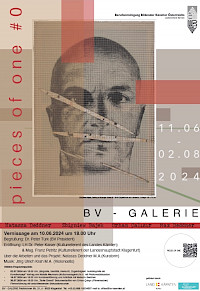
pieces of one
pieces of one addresses the fragmentations and disparities in our society. Through a combination of visual art, installations, and performative elements, the project compellingly depicts the disintegration of social structures and the resulting challenges. It highlights issues such as social inequality, political polarization, and the often inadequate response of institutional actors to these problems.
The idea for the project stemmed from my fundamental belief that all people are equal. Due to my migration background, the question of my identity has always been present throughout my years living in Germany. The issue of one's own identity and the search for it is exacerbated by xenophobia. Latent and increasingly overt racism still prevails in Germany and across Europe. As a result, I sought a way to counteract this.From my perspective, art is a crucial factor in contributing to societal awareness, provided that the interplay of different artistic media offers many people easy access without losing its depth.
pieces of one #0 identity
In the tension between cultural diversity and societal narrow-mindedness, an artistic process emerges that understands the fragmentation of the self as a creative force
Natasza Deddner
 © Zbigniew Bajek, Natasza Deddner
Zbigniew Bajek • Orhan Çalışır • Max Deddner • Natasza Deddner • Jörg Ulrich Krah • Natalia Neumann • Alma Portič • Andreas Zens
BV Gallery in Klagenfurt (A)
funded by:


→ exhibition catalogue - German edition
Triennal IIICarinthia 2023 schock.šok.shock / Art Association of Carinthia
On Triennale IIICarinthia 2023
Interpersonal relationships always leave traces, influencing the protagonists in both positive and negative ways. Human existence is built upon precisely these relationships, if only because human beings are social creatures and cannot survive in isolation. As an emotional negation of the two preceding Triennales, whose mottos were “Head” and “Time,” the term “Shock” primarily stands for a subjective, latent sense of indignation, which was visualized in the projects. Through my countless conversations with the participating artists about their projects during the Triennale, a normative consensus emerged. The causality was astonishing, with only a few exceptions. The veiled narrative, based on six letters, remained rooted in its artistic mental negativity in order to do justice to the challenging and outstanding idea of the Kunstverein.
The ideationally homogeneous concepts of the submitted projects developed into an overall project that, shaped by the diversity of the participating artists, depicts the theme of the state of shock through different artistic media, thereby presenting a diversity of emotional and rational subjectivity.
In my proposal to remove the regional limitation and expand the 2023 Triennale to encompass the entire Alpine-Adriatic region, the diversity of the overall project was further enhanced by the inclusion of international artistic positions. This was not only because Carinthia is internationally embedded within its historical context, and because neither the theme of “Shock” nor art itself can be confined by boundaries, but also because this creates an opportunity for future Triennale projects to advance their opening and expansion beyond borders in every sense, while establishing a platform for potential collaborations and contacts.
Triennale III Carinthia 2023 / Catalogue (German edition)
City–Country(side)-Bus / the multimedia theater production
official project website
trailer