Natasza deddner
conceptual artist
EXPO 2027, under the guiding theme "Play for Humanity", articulates the ambition to make play, movement, and music accessible as universal human practices and to engage an international audience independent of language. What is expected is not an object, but a system that enables experience. My conceptual practice begins where given requirements are translated into structure.
The pavilion is conceived as a spatial expression of Austria and makes its attitude, innovation, way of thinking, and cultural competence internationally perceptible and visible.
Based on these premises, I have developed a spatial installation in which movement organizes perception. The roller coaster functions as a central structuring element within a larger constellation of space, sound, light, and human presence. It describes a continuous line through space that orders rhythm and time. This dynamic is not understood as an event, but as a state. Space becomes perceptible as a temporal configuration.
The installation connects physical experience, sound, and visual translation into a coherent system. Rhythm generates sound; sound is translated in real time into color, form, and light. Two large-scale LED walls function as the visual surface of this process. Sound, image, and spatial dynamics are directly interconnected and continuously evolving.
The installation is designed so that participation emerges through presence. Riding and standing visitors share a perceptual space that extends into the exterior through the glass walls. Acoustic and visual processes also include people outside the enclosed space. Visitors may actively engage or observe. Play unfolds as interaction. Sport appears as physical movement in space. The ride directly activates the body and translates movement into tangible parameters such as rhythm, balance, and acceleration. In this way, sport becomes a universal, non-conditional experience and, as part of the overall installation, accessible to all—in the sense of Play for Humanity. Sound emerges as a process generated by movement and presence.
In accordance with the requirements of the EXPO 2027 call, architecture is an integral part of the concept and serves the spatial organization of experience, participation, and public presence. It functions as the structuring envelope of the installation, organizing visitor flow and openness while establishing a deliberate connection between interior and exterior, without asserting itself as an autonomous object. The glass walls open the installation to the outside. The visual processes unfolding within become part of the public realm. Light, color, and movement enter into a relationship with the surroundings, rendering the entire process visible. Perception is shared.
I developed this concept for Austria because my own way of working aligns with an attitude I experienced there as self-evident: the understanding that complexity does not need to be reduced in order to be accessible. Perception may take time; experience is allowed to unfold. Design means creating conditions under which processes become visible. I perceived Austria as a place where art, technology, economy, and everyday life are not strictly separated. Collaboration arises from mutual respect and from the awareness that different competencies are part of a shared system. The installation emerged from a concrete relationship—from a working reality, from encounters, and from a shared understanding of time, space, and responsibility.
My decision to conceive this concept for the Austrian Pavilion at EXPO 2027 arises from this proximity. Austria is not merely represented, but embodied—through an attitude that connects perception, play, movement, and participation.
Pantha rhei—everything flows—forms the conceptual foundation of this installation. It organizes flow as a spatial experience and renders Play for Humanity visible as a lived process. The work unfolds through the interplay of space, sound, image, and human presence
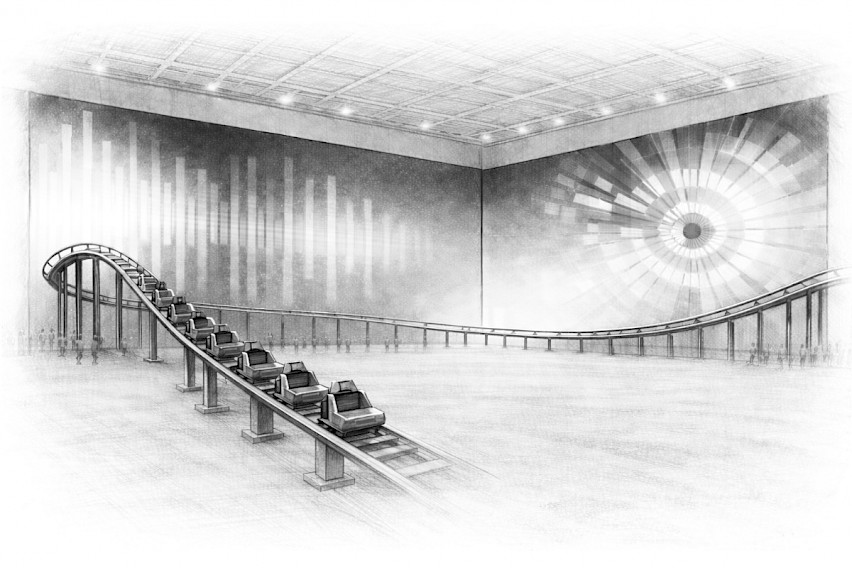
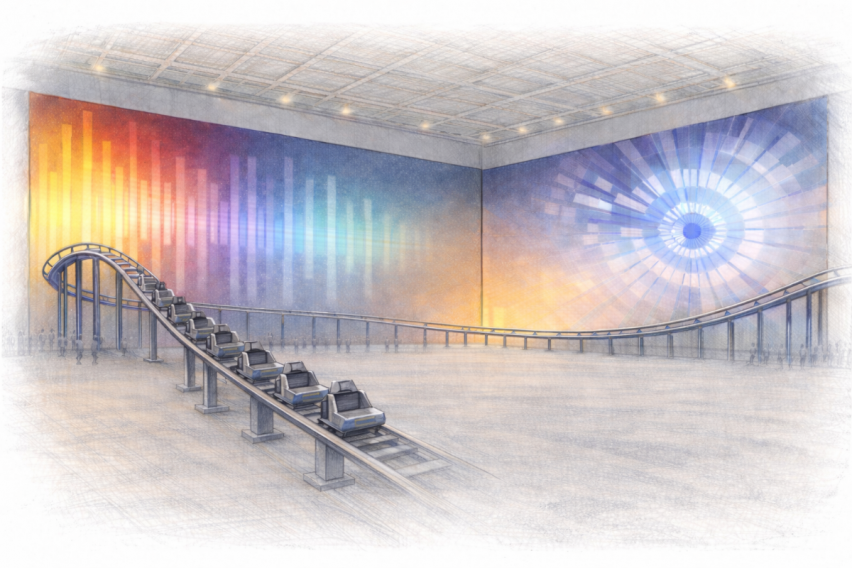
Interior view of the austrian pavilion, ground area 20 × 30 m, height 10 m
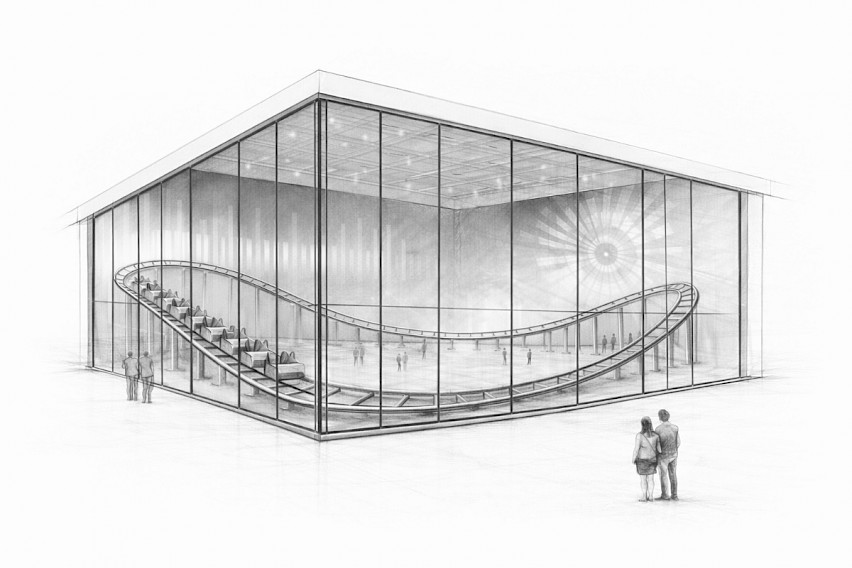
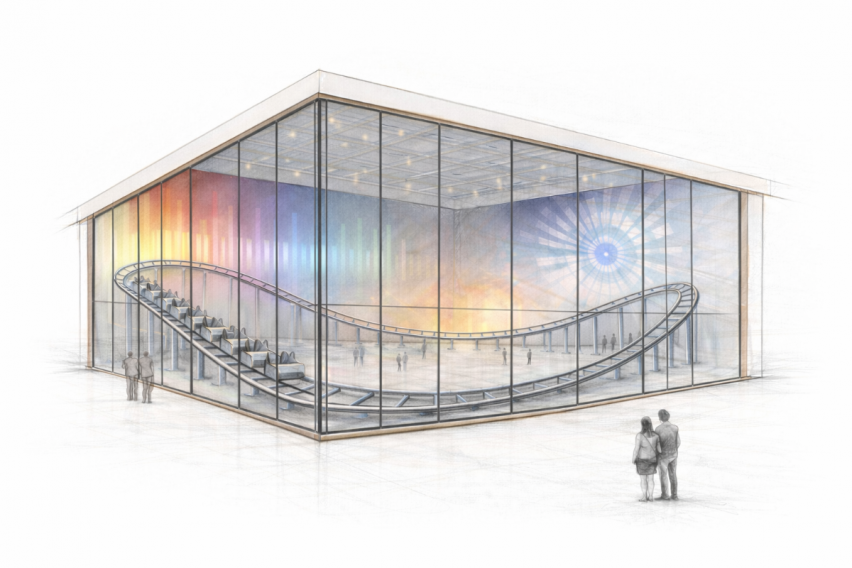
Exterior view